Moon's Surface Revealed

Arjun Mehta
| 06-05-2026
 · Science Team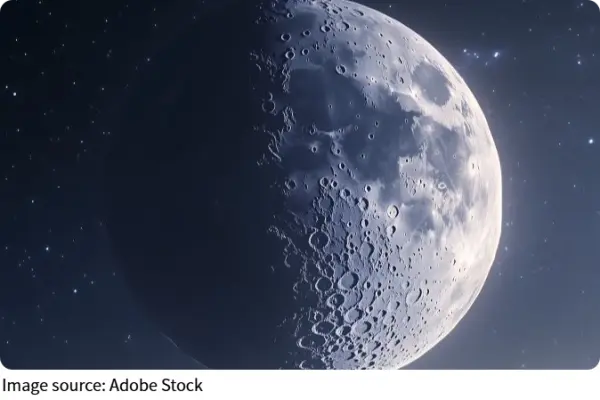
Looking up at the Moon on a clear night, it's hard not to notice its familiar gray glow and scattered dark patches.
But beyond what the unaided eye can see, the Moon's surface is a landscape full of hidden features and secrets, waiting to be uncovered by probes and rovers. Understanding these features helps scientists not only map the Moon but also learn about its history and formation.
Major Lunar Landforms
The Moon's surface is far from flat. Its landscape includes craters, mountains, valleys, and smooth plains, each telling a story about the Moon's past.
1. Impact Craters
Cratering is the most common feature. Billions of years of asteroid impacts have carved out vast craters, from small bowl-shaped pits to enormous basins hundreds of kilometers wide. For example, the Tycho crater, visible even through small telescopes, is surrounded by bright rays of ejected material. Observing these craters helps researchers estimate the Moon's age and the intensity of meteor bombardment over time.
2. Lunar Maria
The dark patches visible from Earth are called maria, Latin for “seas,” though they contain no water. These plains were formed by volcanic lava flows that solidified billions of years ago. By studying the composition of maria, scientists can track the Moon's volcanic activity and internal processes. For instance, Mare Imbrium contains basalt that reveals the presence of ancient lava flows, giving clues about the Moon's thermal evolution.
3. Highlands and Mountains
Contrasting with maria, the Moon's highlands are heavily cratered and older. These areas form the rugged terrain seen around large craters. Some mountain ranges, like the Montes Apenninus, rise thousands of meters and are remnants of massive impacts that reshaped the lunar crust. Exploring these regions offers insight into the Moon's structural formation and the forces that shaped its surface.
Exploration and Discoveries
Lunar probes, landers, and orbiters have revolutionized our understanding of the Moon, revealing features invisible to Earth-based observation.
1. Robotic Missions
Satellites like the Lunar Reconnaissance Orbiter have provided detailed maps of the Moon's surface, showing even small boulders and subtle slopes. These maps are essential for planning future missions and understanding surface composition. For example, identifying shadowed regions near the poles has highlighted areas where water ice may persist, a discovery with potential implications for human exploration.
2. Human Landings
The Apollo missions brought back rock samples that allowed direct study of the Moon's geology. Analysis of these samples revealed that the Moon's surface contains minerals like anorthosite and basalt, confirming that its highlands and maria formed through different processes. Hands-on study of these rocks also helps scientists understand the history of meteor impacts and volcanic activity on the Moon.
3. Remote Sensing Techniques
Modern instruments, such as spectrometers and radar systems, provide information about the Moon's mineral composition and subsurface structures. For example, radar data can detect hidden lava tubes, which could serve as natural shelters for future astronauts. Such discoveries show that even well-known landscapes may hold unseen features that alter our understanding of the Moon.
Why Lunar Features Matter
Studying the Moon is more than academic—it offers practical insights for future exploration and technology.
1. Resource Identification
Mapping minerals and potential ice deposits informs where future missions might extract water or building materials, reducing reliance on Earth for supplies. NASA and other space agencies consider these locations critical for sustainable lunar bases.
2. Planetary Formation Insights
The Moon preserves a record of early solar system events. By examining crater distribution, lava flows, and surface composition, scientists can learn about planetary formation processes, impact histories, and the evolution of planetary bodies in general.

3. Testing Ground for Exploration
Understanding the Moon's surface helps engineers design landers, rovers, and habitats suitable for extreme terrain. For instance, navigating steep crater walls or uneven lava plains requires careful planning, and studying these landscapes in detail improves safety and efficiency for future explorers.
The Moon may look calm and familiar from Earth, but up close, it is a dynamic, textured world with a rich history written in its craters, plains, and mountains. Each observation and discovery brings humanity closer to understanding our nearest celestial neighbor and prepares us for the next steps in space exploration. Spending time learning about these lunar landscapes transforms the way we see the Moon—not just as a bright spot in the night sky, but as a complex world full of stories waiting to be uncovered.